Analogue, DMR, TETRA and PoC Compared
Analogue, DMR, TETRA and PoC are not four grades of the same product. They differ in where coverage comes from, what happens when the network fails…


15 articles
How UHF, VHF, DMR, TETRA and PoC differ, how coverage is calculated, how a channel plan is built, and which technology suits which operation.
Analogue, DMR, TETRA and PoC Compared
Analogue, DMR, TETRA and PoC are not four grades of the same product. They differ in where coverage comes from, what happens when the network fails…
ATEX Radios in Oil and Gas
An ATEX radio is certified as a complete assembly for a specific zone, gas group and temperature class. Reading the marking correctly is what separ…
How to Build a Radio Channel Plan
A channel plan decides who hears whom. It is built from how teams actually work, not from the number of frequencies available: talkgroups per funct…
How to Run an RF Coverage Survey
A coverage survey answers three questions before money is spent: how far the signal reaches, how many repeaters are needed and where, and where the…
Managing a Radio Fleet
Fleet management is the discipline that keeps a growing radio system coherent: an accurate inventory, an ID scheme that encodes role and site, one…
PoC Radios versus Phone Group Calls
A phone group and a PoC radio both use the cellular network, but they are different tools. PoC gives sub-second group voice, a dispatch console, ce…
Portable versus Mobile Radios in the Field
A mobile radio in a vehicle transmits more power through a far better antenna at greater height, so it outranges a handset by a wide margin. Most f…
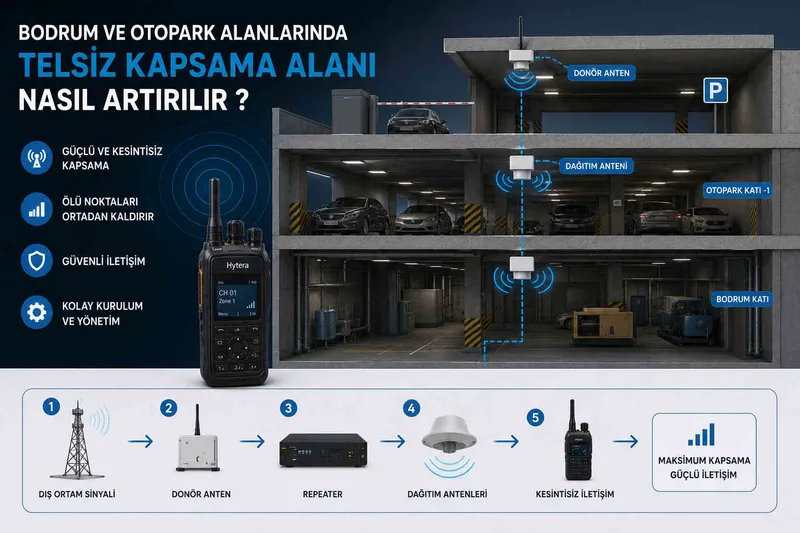
Radio Coverage in Basements and Car Parks
Reinforced concrete, earth and steel attenuate radio signals by tens of decibels, so no handset reaches a basement from outside. Coverage undergrou…
Radio Licensing in Türkiye: What Licensed Professional Radio Means
A licensed professional radio system runs on frequencies assigned to your organisation by the BTK for named sites. That assignment is what makes in…
Radio Systems in Port Operations
Port communication is not one system. Marine VHF handles vessel traffic by international allocation; the terminal, yard and gate need their own net…
Shared Radio Services in Türkiye (OKTH)
OKTH — Ortak Kullanımlı Telsiz Hizmeti — is a shared radio service in which an organisation uses a provider's licensed infrastructure instead of bu…
Simplex and Duplex Radio Explained
In simplex, radios transmit and receive on one frequency and talk directly to each other; coverage is whatever the handsets can reach. In duplex, a…
Single versus Dual Frequency Repeaters
A dual-frequency repeater receives and transmits at the same time on a frequency pair, which needs a duplexer. A single-frequency repeater records…
When to Choose UHF Radios
UHF around 400-470 MHz has a wavelength near 70 cm, short enough to diffract through doorways, stairwells and racking that block longer waves. That…
When to Choose VHF Radios
VHF around 136-174 MHz carries further than UHF over open terrain and across water, and it passes through foliage more readily. The price is antenn…
We deliver not only what you need, but more than you expect .