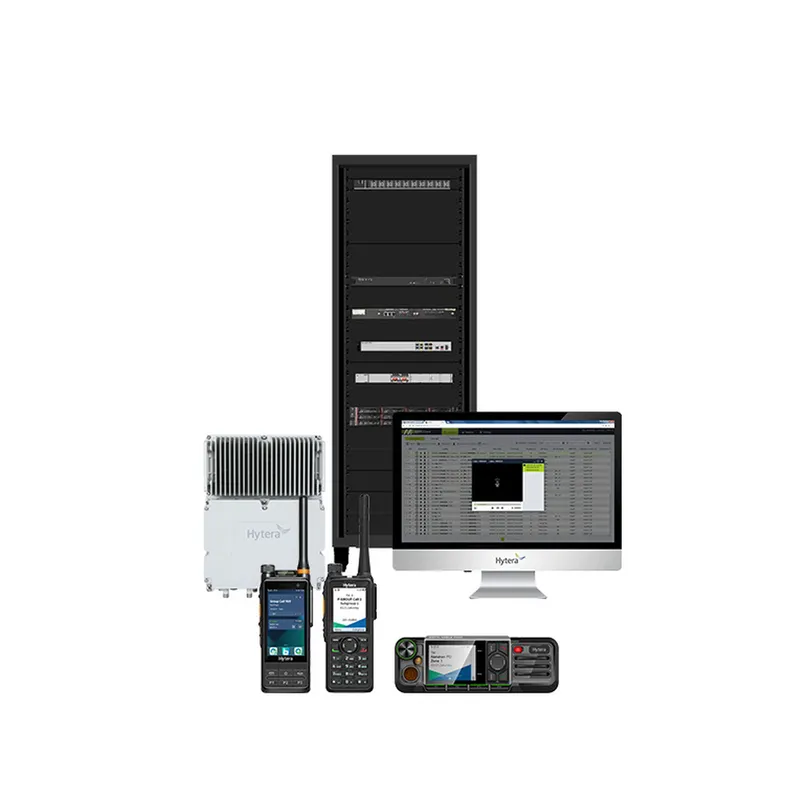
Hytera DMR Trunking Solution


DMR Tier III is the ETSI trunking tier: a control channel assigns traffic slots on demand from a shared pool instead of tying each group to a fixed channel. That yields far higher usable capacity from the same spectrum, with call priority, emergency pre-emption and multi-site roaming.
Tier III is the trunking tier of the DMR standard. Where conventional DMR gives each group a fixed channel, Tier III puts every channel into a shared pool and hands one out for the duration of each call.
On a conventional system, capacity is allocated in advance. Maintenance owns one channel, security another, logistics a third. When maintenance is busy and logistics is idle, the idle channel helps nobody: it cannot be borrowed.
Trunking removes the assignment. A control channel carries signalling only; when a user presses to talk, the controller allocates a free traffic slot, tells both ends which one to use, and reclaims it when the call ends. Statistically, a pool of shared channels serves far more groups than the same number of dedicated ones — the same reason a bank uses one queue for all tellers rather than a queue per teller.
| Conventional (Tier II) | Trunked (Tier III) | |
|---|---|---|
| Channel allocation | Fixed per group, set at programming | On demand, per call |
| Behaviour when busy | User hears a busy channel and retries | Call queues, connects when a slot frees |
| Priority | None; first to key wins | Per user and per talkgroup, with pre-emption |
| Growth | New group needs a new channel | New group needs no new spectrum |
| Multi-site | Manual channel change by the user | Automatic roaming and re-registration |
| Infrastructure | Repeaters only | Repeaters plus a trunking controller |
The right-hand column costs more and needs designing. It is worth it at the point where the left-hand column is producing queues, and not before.
The database is the part that outlives the hardware. A well-structured talkgroup and priority scheme survives two generations of radios; a badly structured one has to be rebuilt every time the organisation changes shape.
Traffic is sized in erlangs — average simultaneous call load — measured or estimated from user count, call frequency and average call length. From that comes the number of traffic channels needed to hold queuing below an acceptable grade of service, typically one or two per cent of calls queued at the busy hour.
Two mistakes recur. Sizing for the average rather than the busy hour produces a system that fails exactly during an incident. Sizing for a headcount that assumes everyone talks at once produces one that is two thirds idle and paid for.
Every frequency in the pool requires a BTK licence, and a multi-site network requires frequency planning that keeps sites from interfering with each other while allowing controlled overlap for roaming. TechnoRF prepares the plan, files the application and holds the documentation for the life of the system.
Municipalities with several field departments, organised industrial zones, energy and utility operators, mines, airports, ports and large campuses. What these share is not headcount but structure: many distinct groups, wide area, and an operation that stops when coordination stops.
Where the requirement is national fleet coverage rather than site capacity, PoC is usually the more economical answer. Where an outage carries risk to life and the budget supports it, TETRA is the higher tier. Talk to us about which line your operation falls on.
When users start waiting for channels rather than for other people to finish speaking. As a rule of thumb, a conventional system starts to strain past roughly six to eight active talkgroups or a few hundred radios, but the honest measure is the traffic study: peak simultaneous calls against slots available. Below that threshold trunking adds cost and a controller to maintain, with no gain.
A designed system does not have a single control channel. Any repeater in the site can assume the control role, and if the trunking controller itself is unreachable the site falls back to conventional operation so that voice keeps working with reduced features. Whether your system does this depends on how it was specified — it is a question to ask before purchase, not after.
Yes. Sites are linked over IP and a radio roams between them, re-registering as it moves, so a talkgroup spans the whole network. The practical constraint is the backhaul: the links between sites must be available and low-latency, because losing the link fragments the system into independent islands.
Each user and each talkgroup carries a priority level, and an emergency call pre-empts a lower-priority conversation already in progress rather than queuing behind it. This is the feature that makes trunking defensible in safety-critical operations: capacity is allocated by importance, not by who pressed the button first.
The Hytera product range, TechnoRF engineering, installation, maintenance, technical service and business continuity planning — brought together into a system designed for how your operation actually works.
We deliver not only what you need, but more than you expect .