Denizli RWE Energy — DMR System Maintenance and Optimisation


Energy operators coordinate switching and maintenance across geographically dispersed and largely unmanned assets, where a communication failure has safety and supply consequences. TechnoRF builds the voice and telemetry layers, with redundancy scaled to what each site’s loss would cost.
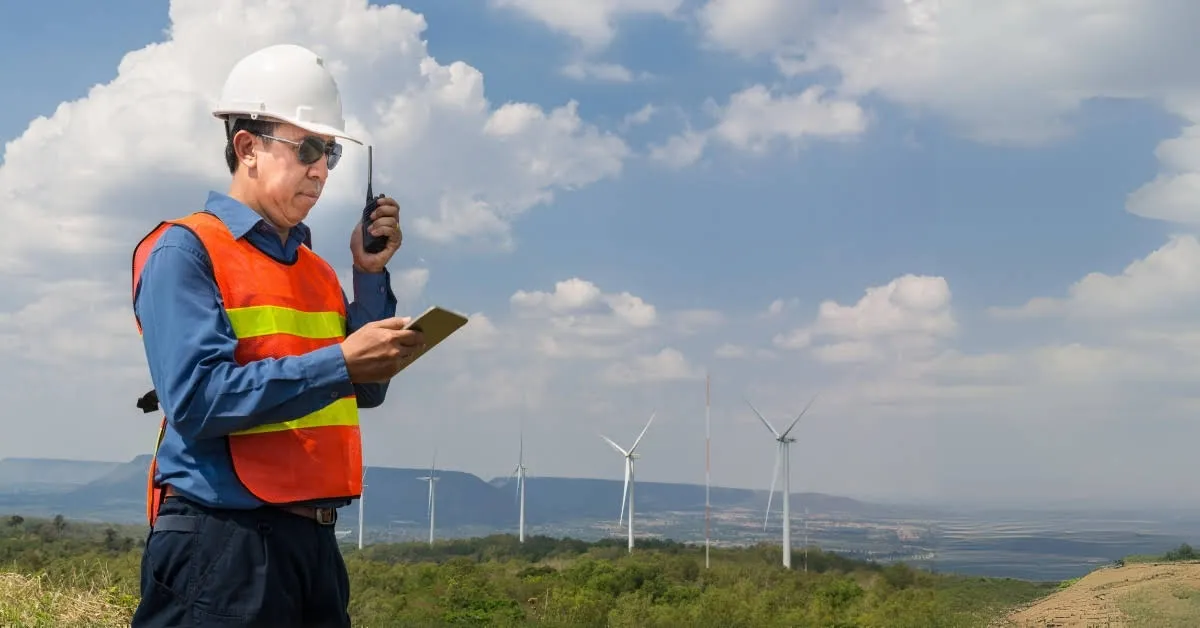
Energy operations are geographically dispersed, largely unmanned, and unforgiving of communication failure — because the work being coordinated is switching high voltage, and a misunderstanding there has consequences beyond the schedule.
Switching communication that cannot fail. Immediate, group-based, recorded, and independent of any commercial network. Switching activity peaks during storms and faults, which is precisely when public networks are least dependable.
Telemetry from sites with nobody in them. Substations, pumping stations, generation sites and renewable installations reporting continuously to a control centre. Small payloads, high reliability, predictable latency. See SCADA and telemetry.
Field coverage where the assets are. Distribution networks run through terrain chosen for the cables, not for radio. Coverage design has to follow the network rather than population.
Certified equipment where the hazard exists. Fuel handling, gas turbines, biogas and biomass, hydrogen and battery rooms are classified areas requiring ATEX certification.
| Asset | Voice | Data |
|---|---|---|
| Generation plant | On-site coverage, groups by discipline | Process and condition monitoring |
| Transmission substations | Switching coordination, recorded | Protection and SCADA, high availability |
| Distribution network | Wide-area crew coverage | Fault indication, switching status |
| Wind and solar sites | Coverage across the site and to turbines | Production and condition telemetry |
| Hydro and dams | Coverage in galleries and structures | Level, flow, gate position |
Uniform redundancy is either too expensive or too thin. The approach that survives scrutiny is to classify sites by what their loss would cost, then design accordingly:
The classification is the operator's, informed by supply impact and safety. Our job is to build to it and to say clearly when a proposed design does not achieve the diversity it claims.
The system is judged during major events, when crews are working long shifts across a wide area, mobile networks are congested or down, and the control centre is coordinating far more activity than usual.
That case sets several design parameters: battery and spare-battery provision for extended shifts, vehicle chargers, coverage that does not depend on mains power at repeater sites, capacity headroom for a traffic level several times normal, and a documented fallback for what happens when a site is lost.
Coverage design across the network, microwave and radio backhaul, telemetry links, certified equipment for classified areas, control-centre integration with recording, BTK licensing, and maintenance with response times matched to site classification. Two of our 48 published reference projects are in the energy sector. Get in touch.
Because switching communication has to be immediate, group-based, recorded, and independent of a network you do not control. A phone call reaches one person, gives no group awareness, and depends on a commercial network that congests during exactly the events — storms, outages, incidents — when switching activity peaks. Radio is specified here for its failure behaviour, not its convenience.
Two separate layers with different requirements. Telemetry from substations and remote plant needs a reliable low-bandwidth path with predictable latency, typically licensed narrowband radio, microwave or cellular. Voice for crews arriving on site needs coverage where the site is, which is often exactly where terrain makes it hardest. Neither substitutes for the other.
In defined places, yes. Fuel handling and storage, gas turbine areas, biogas and biomass plants, battery rooms with hydrogen accumulation and hydrogen facilities are classified zones requiring certified equipment. Most of the network — substations, switchyards, control buildings — is not, so specifying certified equipment estate-wide is unnecessary cost.
It should scale with consequence rather than being applied uniformly. A transmission substation whose loss affects supply to a region deserves a genuinely diverse second path — different route, different power, different technology. A minor distribution point does not. Classifying sites by consequence before designing the network is what keeps the cost defensible.
The Hytera product range, TechnoRF engineering, installation, maintenance, technical service and business continuity planning — brought together into a system designed for how your operation actually works.
We deliver not only what you need, but more than you expect .