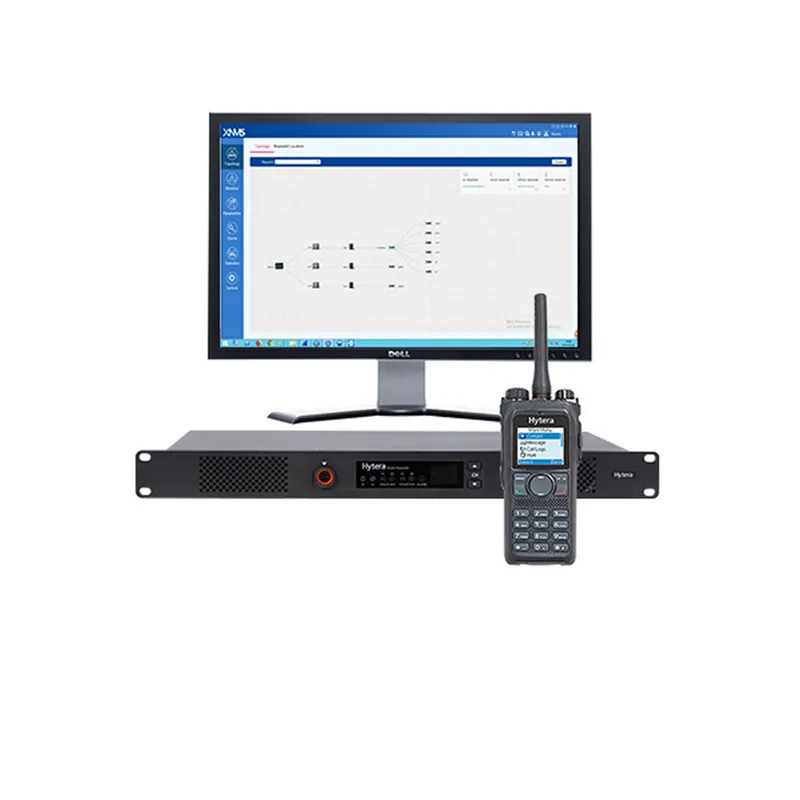
Hytera Extended Pseudo Trunking (XPT) Solution


XPT is Hytera’s distributed trunking architecture. Repeaters negotiate channel allocation between themselves over IP, so a site gains pooled capacity without a central controller. It suits mid-sized single-operator sites that have outgrown conventional DMR but do not need a full trunked network.
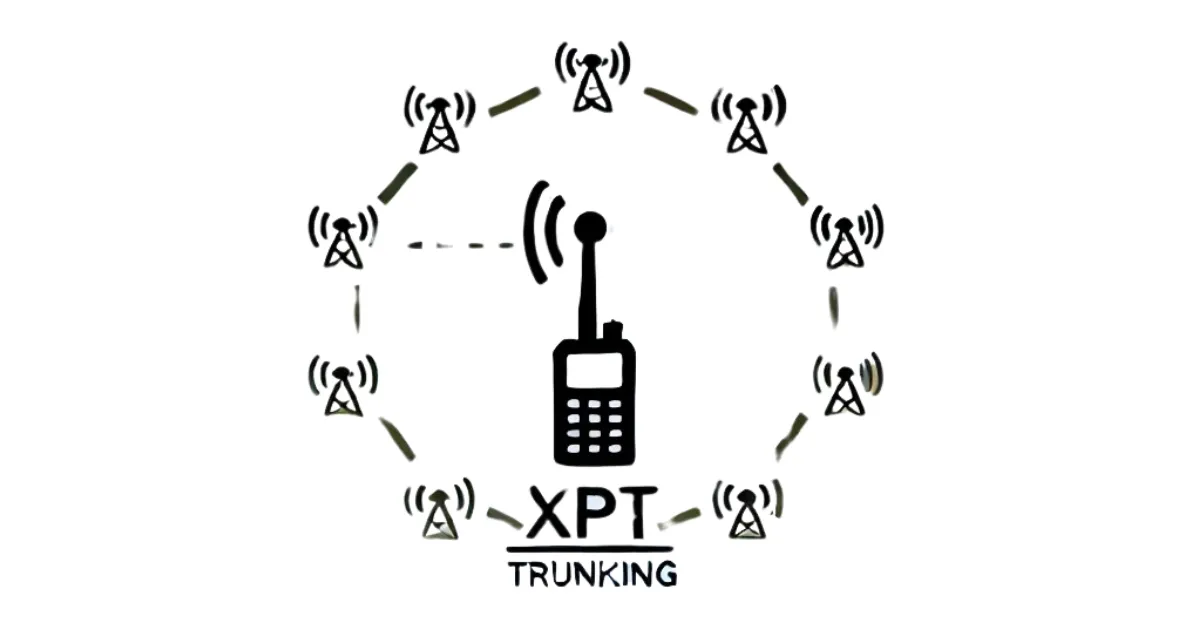
XPT — Extended Pseudo Trunk — is Hytera’s answer to a specific and common situation: a site whose conventional DMR system has run out of headroom, but whose scale does not justify a full Tier III network.
In conventional DMR each talkgroup sits on a fixed channel. In XPT, the repeaters at a site are linked over IP and share their slots as a common pool. When a user keys up, the repeaters decide between themselves which free slot carries the call, and the radio follows automatically.
The user-visible result is the same as trunking: nobody hears a busy channel while capacity sits idle elsewhere. The engineering difference is that there is no controller to buy, house, power and maintain — and no control channel consuming a slot.
| XPT | DMR Tier III | |
|---|---|---|
| Central controller | None | Required |
| Control channel | None — every slot carries traffic | One slot reserved for signalling |
| Standard | Hytera architecture | ETSI TS 102 361-4 |
| Vendor choice | Single vendor | Multi-vendor in principle |
| Typical scale | One site to a few linked sites | Regional or national networks |
| Priority and pre-emption | Basic | Full, per user and per talkgroup |
Read the table as a scale question. Below roughly a few hundred radios on one site, the controller in the right-hand column is overhead. Above it, the features in the right-hand column are the reason to pay for it.
The common thread is concentrated geography and a single operator. Where the fleet is scattered across the country, coverage — not capacity — is the binding constraint, and PoC answers it better.
The sizing input is a traffic study: how many radios, in how many talkgroups, with what call rate at the busiest hour. From that comes the repeater count. Getting this wrong in the cheap direction produces queues at exactly the moment the site is busiest; getting it wrong in the expensive direction produces idle repeaters that still need licences and maintenance.
Coverage is a separate question from capacity and is answered separately, by survey and link-budget analysis. A site can have ample capacity and still have a basement nobody can be reached in.
Radio programming, talkgroup structure, firmware versions and repeater health all need an owner. TechnoRF provides that as a service: scheduled maintenance, programming changes as departments reorganise, spare units, fault response and periodic coverage checks. See support services or get in touch.
XPT has no central controller and no dedicated control channel. The repeaters coordinate between themselves over IP and every slot can carry traffic, which makes a small system cheaper and simpler to run. Tier III in exchange gives standardised multi-site roaming, richer priority handling and vendor independence. XPT is a Hytera architecture: the system is single-vendor by design.
Capacity scales with repeaters. Each repeater adds two slots to the pool, and a site typically runs up to eight repeaters — sixteen slots — under one XPT system. In practice that comfortably serves several hundred radios in a dozen talkgroups, which covers most factories, campuses and logistics centres.
Yes, XPT supports multi-site operation with roaming between linked sites over IP. It is not the same as Tier III wide-area trunking, and it is not the right tool for a network spanning provinces. For a plant with several buildings, or a campus with separated zones, it works well.
Usually yes, and this is a common path. The same Hytera repeaters and, in most cases, the same radios support both; moving to XPT is a licence and configuration change rather than a hardware replacement. Confirming this for your specific models before purchase is part of the design work.
The Hytera product range, TechnoRF engineering, installation, maintenance, technical service and business continuity planning — brought together into a system designed for how your operation actually works.
We deliver not only what you need, but more than you expect .