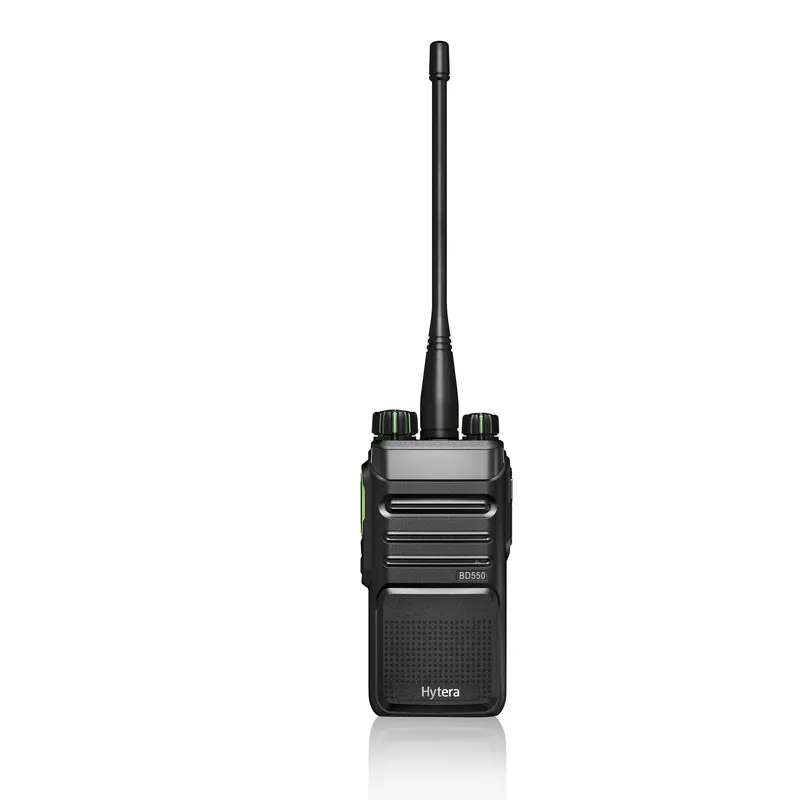
Hytera BD555 Professional DMR Handportable Radio



TechnoRF built a professional digital radio network for Mersin University to strengthen campus security coordination and hold communication even during periods of peak student movement, combining a dual-slot digital repeater with Hytera BD555 handsets. Field testing across the campus established the optimum antenna position, with the aim of reliable contact for security teams across the main campus, the new faculty, open areas, building perimeters and access points. A fibre-backed IP interconnect module provides uninterrupted roaming between the main campus and the new faculty, so staff move between areas without channel confusion. The BD555 handsets were programmed for daily security use, with an emergency call button that alerts the security centre directly, and digital recording that supports post-incident review.
Campus security teams move through pedestrian areas, faculty buildings, car parks, social spaces, entrance gates and administrative points across a working day. The design was drawn from that pattern rather than from a site plan: coverage was tested where staff actually walk, and the antenna position was chosen from measurement rather than from the most convenient mounting point. This is what distinguishes a network that covers the campus from one that covers the buildings.
A dual-slot digital repeater carries two independent conversations on one frequency pair, which doubles usable capacity without a second frequency allocation. On a campus this matters at exactly the moments the system is most needed — an event, an incident, the start of an academic term — when a single-channel system saturates and calls queue behind each other. The second slot also allows different security functions to be separated without competing for the same talk path.
Managing coverage for separate buildings or faculties from a single point is not always sufficient. IP interconnect lets separate repeaters or coverage points work together over the network, and a fibre-backed link raises the reliability of that connection. In practice this produced roaming between the main campus and the new faculty: a member of staff crossing between them stays in the same talkgroup instead of having to change channel, which is the change that removes both dropped calls and the confusion that follows them.
In some campus incidents seconds decide the outcome. An emergency call button lets an officer alert the security centre immediately, from wherever they are, with one action and without navigating a menu. Digital recording addresses the other half: it allows the traffic around an incident to be reviewed afterwards, processes to be audited and, where necessary, a record to be produced as evidence. Together these make the security operation more transparent and more reviewable.
Handset price and catalogue data are not sufficient. Campus area, building density, repeater capacity, whether IP interconnect is required, link redundancy, roaming behaviour, emergency call arrangements, digital recording, battery endurance, accessory compatibility, documentation, training, maintenance and technical service support all have to be evaluated together. TechnoRF provides survey, coverage testing, system design, installation and sustained service for universities in Turkey.
We deliver not only what you need, but more than you expect .