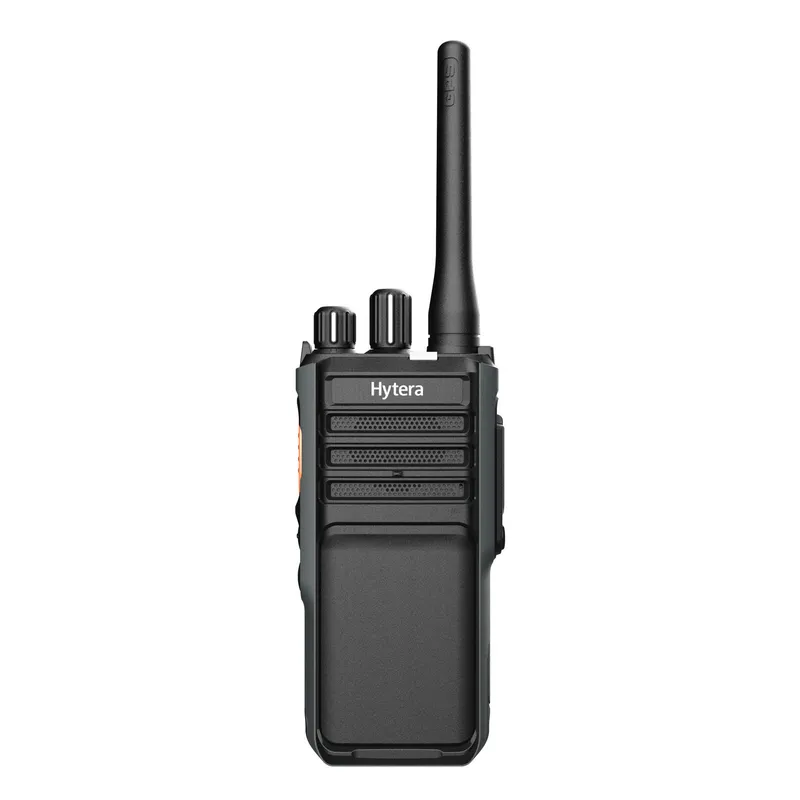
Hytera HP509 Professional DMR Handportable Radio



Kocaeli Körfez State Hospital upgraded its analogue radio infrastructure to a Hytera HP5 based digital system under TechnoRF's guidance, driven by rising annual patient volume and the need for faster coordination during critical code procedures. Dual-mode handsets were configured into four digital talkgroups — emergency, security, technical services and management — so that a code blue or code white alarm reaches the relevant units immediately while routine traffic stops competing with it. A redundant repeater module improves system continuity, and in-ceiling leaky-feeder cabling extended coverage down to the basement imaging areas. Training raised the accuracy of staff radio use significantly, particularly in the use of talkgroups and alarm routing.
The reason to separate emergency, security, technical services and management is not capacity but attention. On a single shared channel every team hears every exchange, and the predictable human response is to stop listening closely — which is exactly the wrong state to be in when a code is raised. Splitting traffic by function means each group hears a channel that is mostly relevant to it, so an unexpected call registers. The measurable effect is on response organisation rather than on call volume.
A hospital cannot schedule its incidents around equipment maintenance. A single repeater is a single point of failure for the entire in-building network, and its failure removes coverage precisely in the interior areas that have no alternative path. A redundant module means a repeater fault becomes a maintenance task rather than an outage, and it allows planned work to be done during the day rather than at three in the morning.
Basement imaging suites are the hardest coverage problem in a hospital and among the most important: they are below grade, structurally massive, and in several cases deliberately shielded. A point-source antenna in a corridor outside will not penetrate them. Radiating cable run in the ceiling void distributes a low-level signal along the whole route, which is what produces continuous coverage in a long, sealed space rather than one strong spot and two dead ends either side of it.
Digital talkgroups and alarm routing only work if staff use them as designed — the right group for the right traffic, the right key for the right code. This is the part of a hospital radio project most often left to a handover document, and it is the part that decides whether the design survives contact with a busy shift. Structured training after commissioning produced a marked improvement in correct use, which is the only measure that matters once the equipment is installed.
We deliver not only what you need, but more than you expect .