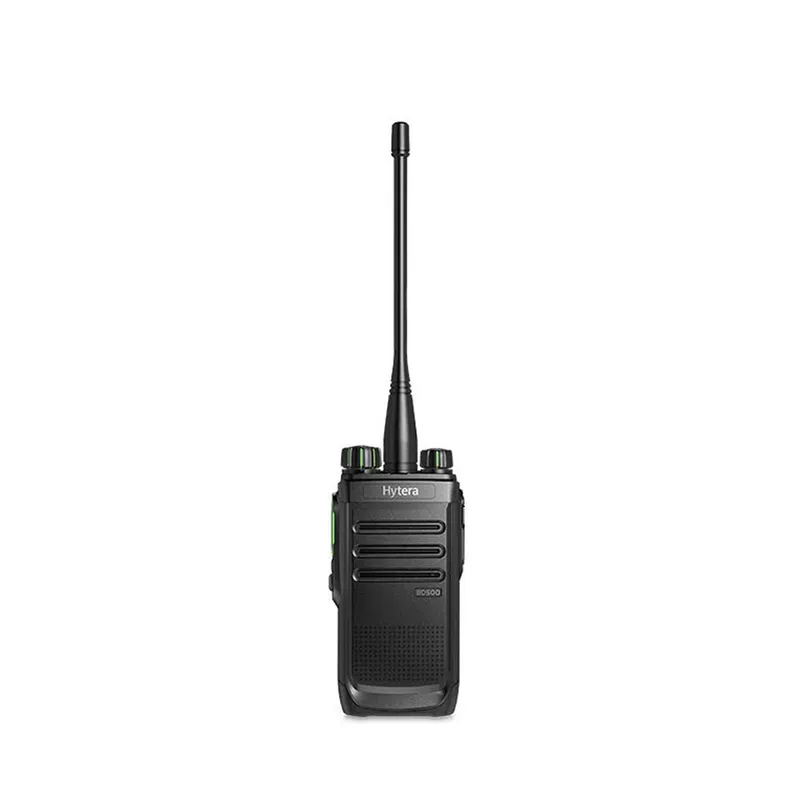
Hytera BD505 Professional DMR Handportable Radio



The Hatay Provincial Health Directorate equipped the reorganised security unit at Antakya State Hospital with Hytera BD505 digital radios supplied by TechnoRF. The requirement was uninterrupted, intelligible communication for security staff across a hospital complex that had expanded into additional modular blocks after the earthquake. TechnoRF carried out enclosed-corridor testing against the new layout and optimised repeater and antenna placement for coverage continuity. The BD505's noise suppression and long battery life were configured so that shift changeover does not create a communication gap, and the security centre's fast recall function shortens the time needed to organise teams during emergency and patient evacuation drills.
A radio plan is drawn against a building. When that building acquires modular blocks, new circulation routes and changed usage after a disaster, the plan does not survive the change — and the failure is invisible until someone needs coverage in a corridor that did not exist when the survey was done. Rather than assume the previous arrangement still applied, the coverage was re-measured against the layout as it now stands. This is the ordinary consequence of a hospital being rebuilt in stages, and it is the part most often skipped.
Enclosed corridors are where hospital coverage is decided. They are long, structurally lined, frequently below or between blocks, and they are the routes security staff actually walk. Testing them individually — rather than sampling open areas and interpolating — is what locates the gaps that matter. Repeater and antenna placement was then set from those measurements, so that the transitions between modular blocks are covered rather than the interiors alone.
A security fleet fails at shift change more often than at any other moment: radios come off a charger that was not used, batteries that survived a quiet shift do not survive a busy one, and the incoming team starts work with equipment that will not last. Configuring the fleet around the actual shift pattern — endurance, charging positions, and how many spare batteries are in circulation — is what removes that gap. It is an operational decision as much as a technical one, and it is settled at commissioning or not at all.
In a facility rebuilt after an earthquake, the radio system is not only a security tool. It is the fallback that continues to function when the structured cabling, the paging system and the mobile network do not, and it is what evacuation drills are actually run on. That dual role is why coverage in this building was treated as infrastructure rather than as a departmental purchase. TechnoRF provides survey, coverage design, repeater installation, antenna optimisation, programming and ongoing service for health institutions in Turkey.
We deliver not only what you need, but more than you expect .