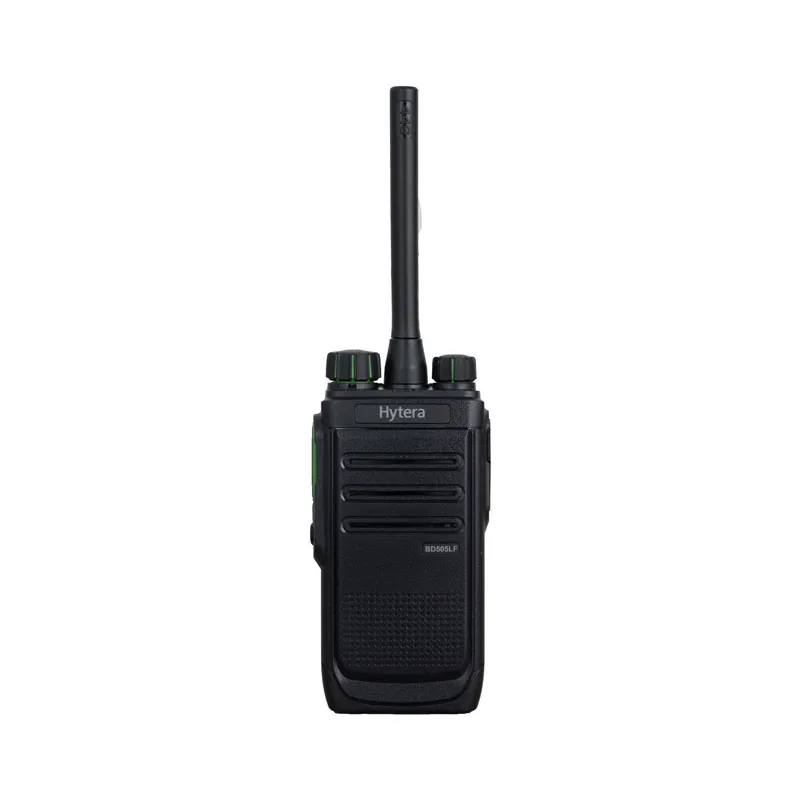
Hytera BD505LF Licence-Free DMR Handportable Radio



Baburtech moved its field service team to the licence-free Hytera BD505LF to improve mobile coordination and speed up communication in its operations, working with TechnoRF on the migration. Operating in the licence-exempt PMR446 band removes annual frequency fees and lets the company put its communication budget to better use. Before delivery TechnoRF built a channel plan matched to Baburtech's field service structure and integrated voice encryption and remote kill-code. The light build, wide channel capacity and mixed digital-analogue operating mode give technicians flexibility across varying site conditions, and headsets and speaker microphones were distributed for use in noisy machinery environments. Post-project review showed a marked reduction in fault turnaround time.
Licensed radio in Turkey carries an annual frequency fee per channel, an application process and a renewal obligation. For an organisation with a large fleet that cost is proportionally small; for a field service team of a dozen technicians it is a meaningful share of what the system costs to run. The licence-exempt PMR446 band removes it entirely. The trade-off is real and has to be understood: transmit power is capped by regulation, the band is shared with anyone else using it nearby, and no exclusive allocation is possible. For coordination across a site or a working area, that trade is usually the right one.
Licence-exempt does not have to mean analogue. A digital handset in this band brings clearer audio at the edge of range, addressable calling instead of an open channel, and the ability to encrypt — none of which are available on a consumer analogue set. Mixed digital-analogue operation matters during a transition, because it lets a fleet migrate progressively while remaining able to work with whatever is already in the field.
Radios delivered on factory defaults get used on factory defaults, and the result is a fleet that shares one channel with every other unprogrammed set in the vicinity. Building the channel plan around the actual service structure — which teams talk to which, what the dispatcher needs to reach, which groups must not interfere — before the devices arrive means the system is used as designed from the first day rather than being reprogrammed after the first bad week.
Field service traffic carries customer names, site addresses and access details. On an open shared band that is readable by anyone within range with a matching set, which is a commercial exposure rather than a theoretical one. Voice encryption closes it. Remote kill-code addresses the other risk that grows with a mobile fleet: a handset that leaves with a departing technician or is lost on site can be disabled rather than remaining live on the company's channel.
In a noisy machinery environment a handheld held to the ear is unusable, and a technician with both hands occupied will not answer it at all. Headsets and speaker microphones are not an upsell here; they are what makes the radio answerable in the conditions the work actually happens in. Fault turnaround time improved because calls were answered, not because the radios transmitted further.
We deliver not only what you need, but more than you expect .